Ngā Kaimoana: A Traditional Larder
Long before the first marine farms appeared in the 1960s, the Marlborough Sounds were a vital food basket for Māori. For centuries following their arrival in Aotearoa, tangata whenua harvested kaimoana (seafood) from these reefs, with species like kūtai (green mussels), kuku (blue mussels), and pāua being essential staples. Oral histories record that local iwi practised early forms of resource management, transplanting shellfish and seaweed closer to their kāinga (villages) to ensure accessibility during bad weather.
Areas such as Waitohi / Picton Harbour and Waikawa Bay were revered as Pātaka Kai (food cupboards), meticulously managed under the principles of kaitiakitanga (guardianship). Permission was required from local kaitiaki to harvest in specific areas, ensuring sustainability. This enduring connection continues today, with local iwi standing as significant leaders and stakeholders in the modern industry, bridging ancient traditions with modern commerce.
Crisis and Legislation: The Birth of an Industry
The modern industry was born out of ecological necessity. By the mid-1960s, the wild mussel dredge fisheries in the Hauraki Gulf and Tasman Bay had collapsed due to overfishing.
This crisis sparked an urgent search for a sustainable alternative, turning attention towards the European practice of aquaculture.
The Marine Farming Act 1968 was a pivotal piece of legislation designed to encourage the farming of sea life rather than its extraction.
In response, the New Zealand Government passed this Act to create a legal framework for the industry. It empowered pioneers to look at the Marlborough Sounds - with its clean water, deep bays, and high tidal flow - as the perfect laboratory for a new way of fishing.
Trial, Error, and a Happy Accident
The industry's origins were marked by trial and error. Early pioneers began experimenting with raft cultivation, a method adapted from Spain. They would hang ropes from large wooden rafts, upon which mussel spat (larvae) would settle and grow. Interestingly, many of these first experimental licenses were largely focused on oysters. However, farmers faced a constant struggle: their equipment was perpetually encrusted with wild mussel spat.
It was a "happy accident" of history when pioneers realised that this native "pest" grew at an astonishing rate in Marlborough's waters.
The focus shifted rapidly from oysters to mussels, utilising primitive rafts made of concrete pontoons, softwood timber, and even plastic drums to suspend ropes into the water.
The Longline Revolution
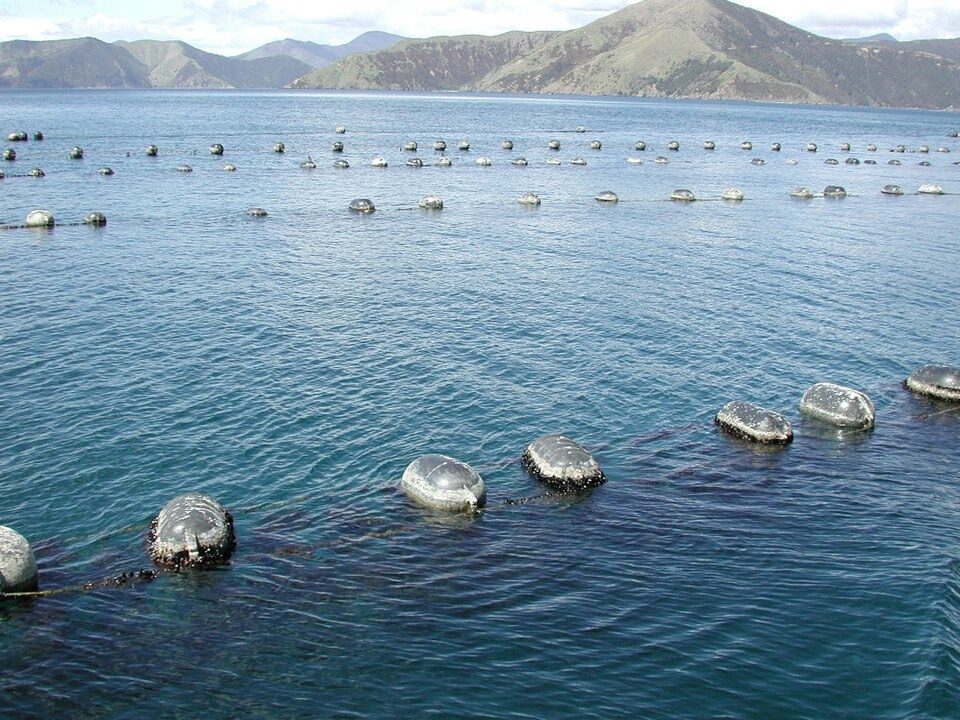
While the early rafts proved the concept, they were cumbersome, heavy, expensive, and vulnerable to the violent storms that can funnel through the Sounds. In the mid-1970s, the industry looked overseas for a solution, adapting and refining the continuous longline system. This method used a backbone rope held up by plastic floats, with "dropper" lines of mussels hanging beneath the surface. It was a technological leap that allowed farms to withstand rougher water and mechanised the harvesting process. The Marine Farming Association, formed in 1975, was instrumental in sharing this knowledge and professionalising the sector.
From Green-Lipped to Greenshell™
The native New Zealand green-lipped mussel, distinguished by its vibrant green shell, became the cornerstone of the industry. However, producing the mussels was only half the battle; selling them to a world that had never seen a green-shelled mussel was another. In the United States, the term "Green-lipped" was viewed as unappealing.
In a stroke of marketing genius in the 1980s, the industry trademarked the name Greenshell™. This re-branding, combined with the development of rapid processing technology that could steam-open and snap-freeze millions of mussels, transformed a local delicacy into a premium international export product. Havelock, once a quiet town with a history rooted in timber milling and the Wakamarina gold rush, rebranded itself as the "Greenshell Mussel Capital of the World."
The Salmon Pioneer
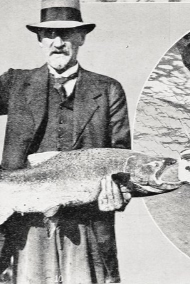
Before the modern salmon industry could exist, the fish itself had to be introduced to New Zealand waters. This monumental task fell to Lake Falconer Ayson, the country's visionary Chief Inspector of Fisheries (1899 - 1926). At the turn of the 20th century, European settlers were desperate to establish the Atlantic salmon, the "King of Fish," for sport. Ayson oversaw the release of millions of Atlantic fry into the Waiau River system, but the project was a disappointment because the fish failed to establish the sea-run populations necessary for true success, eventually becoming landlocked.
Undeterred, Ayson turned his attention to the Pacific. In 1900, he visited the Baird Hatchery on the McCloud River in California, returning with a shipment of Quinnat (King) salmon eggs. Unlike previous haphazard attempts, Ayson adopted a strategy of "concentration," releasing massive numbers into a single system - the Waitaki River - via a purpose-built hatchery at Hakataramea. His logic proved sound. By 1907, the fish had established self-sustaining runs and began spreading naturally to the Rakaia and Rangitata rivers, creating the wild genetic stock that underpins today's luxury industry.
King Salmon: A Premium Catch
While mussel farming was booming, a second wave of aquaculture arrived in the 1980s: commercial salmon farming. Unlike the Atlantic Salmon farmed in Europe, Marlborough focused on the Chinook (King) Salmon, the very species Ayson had established nearly a century earlier.
"I anticipate that the Pelorus and Queen Charlotte Sounds will be to New Zealand what the Puget Sounds are to America." - L.F. Ayson, 1922
The deep, cool, and fast-flowing waters of the outer Sounds provided the unique conditions required for this species to thrive. Through the use of advanced sea-pen technology and rigorous environmental monitoring, Marlborough became one of the only regions in the world to successfully produce King Salmon on a commercial scale, adding a high-value luxury product to the region's portfolio.
Economic and Cultural Impact
The rise of aquaculture fundamentally reshaped the economic landscape of Marlborough. It created thousands of jobs, not just on the farms but also in processing plants, transportation, research, and marketing. It revitalised small coastal communities and provided a new, sustainable economic base for the region, moving beyond traditional land-based farming. The industry's success is a testament to the innovation, resilience, and hard work of the early pioneers who saw potential in the quiet waters of the Sounds.