The Age of Horsepower and Steel
In the early colonial period, farming in Marlborough was a physically demanding enterprise reliant on manual labour and animal strength. The first essential tool for cultivation was the plough. Early models were single-furrow walking ploughs, often imported from Britain, which required considerable skill and strength to guide behind a team of draught horses or bullocks.
As local foundries and engineering firms were established in New Zealand, domestic manufacturing grew. Companies like Reid & Gray of Otago and P & D Duncan of Canterbury became famous for producing robust ploughs, harrows, and seed drills specifically designed for tough local conditions. These implements were the backbone of Marlborough's early grain and crop farming, allowing settlers to break in the land and establish the first farms on the Wairau Plain.
The Steam Revolution on the Plains
The late 19th and early 20th centuries witnessed the arrival of a transformative power source: steam. Large, heavy steam traction engines began to appear on the larger estates of Marlborough. These powerful machines were too expensive for most individual farmers, leading to the rise of contracting businesses that would travel from farm to farm.
Their primary roles were twofold: threshing and ploughing. For threshing, the traction engine would power a separate threshing mill, separating grain from the stalk far more efficiently than the old manual flailing methods. For cultivation, giant multi-furrow balance ploughs were winched back and forth across fields between two traction engines, allowing for deep and rapid cultivation of large areas that was impossible with horse teams alone. These engines were a common sight during the harvest and ploughing seasons, their smoke stacks visible for miles across the plains.
The Tractor Arrives in Marlborough
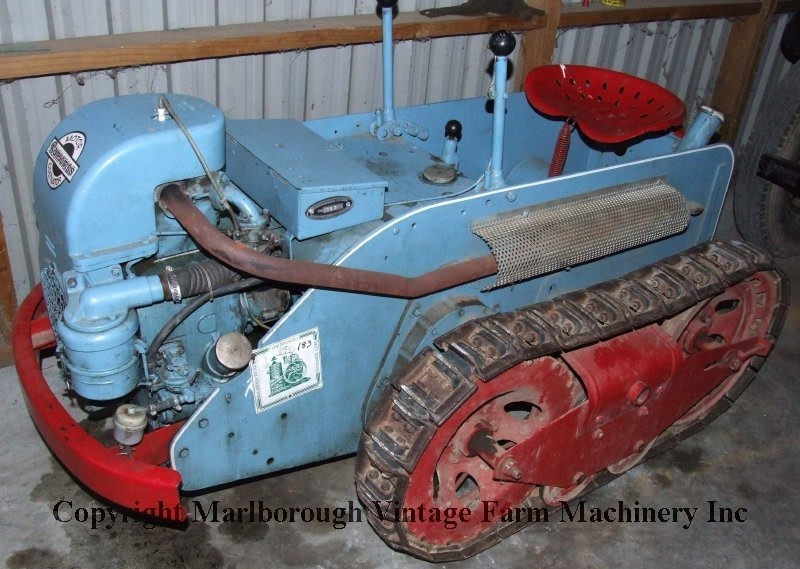
The true revolution in farm power came with the arrival of the internal combustion engine tractor. While some early, heavy models appeared before World War I, it was the lightweight, affordable, and reliable tractors of the 1920s and 30s, such as the Fordson and models from McCormick-Deering and Caterpillar, that truly changed the face of Marlborough farming.
A single person operating a tractor could plough, cultivate, and harvest faster than a large team of horses and men. This dramatically increased productivity and reduced the need for manual farm labour, accelerating the pace of agricultural development. The versatility of the tractor, able to pull a wide variety of implements, made it the indispensable heart of the modernising farm.
Harvesting the Bounty: From Scythe to Combine
The mechanisation of the harvest was another critical development. The slow, laborious process of cutting crops with a scythe or sickle gave way to the horse-drawn reaper-and-binder, which cut the crop and tied it into sheaves. These sheaves still needed to be stooked by hand to dry before being carted to a stationary threshing mill.
The ultimate innovation was the combine harvester. Early models, like the Australian-made Sunshine Harvester, were often pulled by a large team of horses or a traction engine. These remarkable machines combined the reaping, threshing, and cleaning of the grain into a single pass across the field. The later development of self-propelled combine harvesters in the mid-20th century completed the mechanisation of the grain harvest, a process that is fundamental to Marlborough's mixed cropping history.
A Legacy Preserved at Brayshaw Park
Marlborough is fortunate to have one of New Zealand's most significant collections of vintage farm machinery, preserved and displayed at Brayshaw Heritage Park. The park provides a tangible link to every era of this technological evolution. Visitors can see the simple horse-drawn ploughs that first broke the land, the magnificent steam traction engines that powered the agricultural revolution, and the early tractors and harvesters that heralded the modern era. This collection is not just a display of old machines; it is a powerful tribute to the engineering ingenuity and the hard work of generations of Marlborough farmers who utilised this technology to develop the productive landscape we see today.