Te Pokohiwi o Kupe | Wairau Bar
The story of human settlement in Aotearoa New Zealand begins here. Te Pokohiwi o Kupe / Wairau Bar, a windswept gravel bar at the mouth of the Wairau River, is one of the most significant archaeological and cultural sites in the nation. It is a place of profound importance, holding the kōiwi tūpuna (ancestral remains) and taonga (treasures) of the very first generation of Polynesian voyagers to make this land their home, over 700 years ago. For their direct descendants, Rangitāne o Wairau, it is a wāhi tapu (sacred place) and the spiritual centre of their homeland. This is not just a Marlborough story; it is the origin story of Māori culture and the founding settlement of Aotearoa.

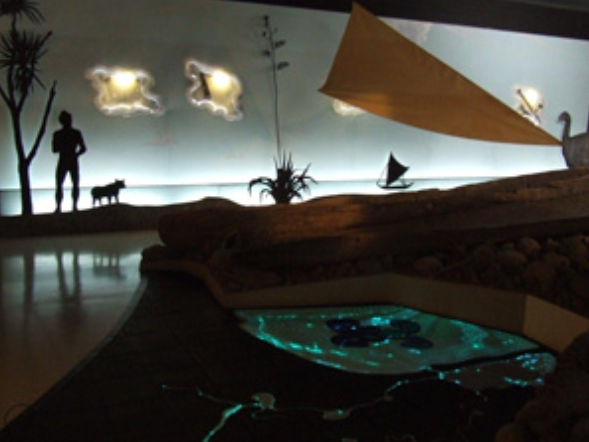
The First Tūpuna: New Zealand's Earliest Settlement
For decades, the precise origins of Māori were a matter of academic theory. Te Pokohiwi provided the first conclusive, tangible proof.
Through detailed archaeological excavation and modern scientific analysis, we now know that this site was a large, thriving, and permanent settlement, established around 1280 - 1300 AD. It was clear this was not a temporary camp; it was a home for a community of at least 200 people, a "founding village" for the exploration and settlement of Aotearoa.
Scientific analysis of the kōiwi tūpuna buried at the site has confirmed this. Advanced DNA and isotope analysis of teeth, which holds a chemical signature of the food and water consumed in childhood, revealed that many of these individuals were not born in Aotearoa. Their diet was consistent with that of East Polynesia, meaning they were part of the first generation of voyagers to make the extraordinary journey across the Pacific.
This was the scientific proof that oral histories had always maintained: these were the original arrivals from Hawaiki.
A Land of Abundance
These first explorers were master navigators who selected Te Pokohiwi for its immense natural wealth. It was a perfect intersection of resources. The vast Wairau lagoons teemed with shellfish, eels, and waterfowl. The river gave access to the interior, and the surrounding plains were home to thousands of moa, a resource that provided abundant protein, with evidence that over 4,000 moa were consumed at the site. The sea provided seals, whales, and fish.
This abundance allowed a large community to thrive, to practice their culture, and to establish a base from which to explore and settle the new islands they had discovered.
The Discovery and the Taonga
This incredible history was famously uncovered by a 10-year-old schoolboy, Jim Eyles, in 1939. While fossicking, he found a 20cm-long moa egg and other strange artefacts. This discovery brought archaeologist Roger Duff from the Canterbury Museum, who began excavations that would rewrite New Zealand's history. The excavations unearthed the richest and most diverse range of taonga from this early settlement period ever found.
The treasures found were stunning, and provided a direct cultural link to East Polynesia. They included detailed necklaces made from moa bone reels, sperm whale tooth pendants, and carved serpentine. The site was also a massive industrial hub. It was a factory for the production of stone adzes (toki), made from the prized pakohe (argillite) quarried from the nearby ranges.
These superior tools were a major trade commodity, and Wairau Bar adzes have been found at archaeological sites all over New Zealand, demonstrating the central economic and technological importance of the settlement to the entire country.
A Sacred Place: The Journey Home
The excavations of the mid-20th century, while scientifically groundbreaking, were conducted in a different era. Over 40 kōiwi tūpuna (ancestral remains) were removed from their resting places and held in the Canterbury Museum for decades. For their descendants, Rangitāne o Wairau, this was a source of profound and enduring mamae (pain), a spiritual disconnection from their founding ancestors. A tribal elder, Peter MacDonald, protested the removal at the time, and his legacy of protest was passed down through generations.
After a long and heartfelt campaign, this grievance was finally addressed.
In April 2009, in a series of deeply emotional ceremonies, the kōiwi tūpuna were finally brought home.
Rangitāne elders carried their ancestors back to Te Pokohiwi and reburied them in the land where they belonged. This act of repatriation was a landmark event, restoring the dignity of the tūpuna and the spiritual integrity of the site.
Today, Te Pokohiwi o Kupe / Wairau Bar is a wāhi tapu of the highest order. It is off-limits to the public, a sacred and private place of remembrance, forever protected by its kaitiaki (guardians).
A New Era of Partnership and Research
The 2009 repatriation of the tūpuna from the Canterbury Museum marked a new era of partnership, replacing the distress of the past with a new relationship built on an equal footing. This has allowed for respectful, iwi-led scientific inquiry.
A prominent example is the research being conducted by Rangitāne o Wairau trustees, including historian Dr. Peter Meihana and Keelan Walker. In partnership with researchers from Te Papa and Otago University, taonga samples are being sent to Harvard University for analysis using a new technology called Zooarchaeology by Mass Spectrometry (ZooMS). This minimally invasive technique can extract collagen from taonga, such as a dolphin tooth necklace, to identify the exact species. This will help determine if the animal lived in Aotearoa or the tropical Pacific, adding another layer of scientific proof to the oral histories of migration - a project Keelan Walker's company, Loud Noise Media, is documenting to share with the iwi.
The Eight Iwi of Te Tauihu
The story of Te Pokohiwi is the beginning of a much longer history of Māori in Te Tauihu (the top of the South Island). The region's rich resources, strategic location, and valuable minerals made it a vital centre for migration and trade for centuries.
Following the first peoples (often known as Waitaha), the traditions of Ngāti Māmoe and Ngāi Tahu were woven into the landscape. Later, migrations of iwi from the Kurahaupō waka, including Rangitāne o Wairau, Ngāti Kuia, and Ngāti Apa ki te Rā Tō, established themselves as tangata whenua. In the 1820s and 1830s, a series of heke (migrations) brought iwi from the North Island, including Ngāti Toa Rangatira (led by the famed chief Te Rauparaha), and the four Taranaki iwi of Ngāti Koata, Ngāti Rārua, Ngāti Tama ki Te Tauihu, and Te Ātiawa o Te Waka-a-Māui. These iwi arrived and established their own permanent place and rights within the region through conquest, occupation, and intermarriage.
Today, these eight iwi are recognised as tangata whenua in Te Tauihu, each with its own rohe (territory) and enduring connection to the land and sea.
Rangatira and Leaders of the Region
Te Tauihu has been shaped by countless reputable Māori leaders. This begins with the foundational explorer Kupe, who named Te Pokohiwi (The Shoulder of Kupe). It includes the ancestor Rākaihautū of the Uruao waka, who is credited with shaping the region's lakes.
In the 19th century, leaders like Te Rauparaha and his elder brother Nohorua of Ngāti Toa fundamentally reshaped the political landscape. This legacy of leadership continues today. Dr. Peter Meihana (Ngāti Kuia, Rangitāne, Ngāti Apa) is one of New Zealand's foremost Māori historians, a lead treaty negotiator, and a key voice in decolonising the region's history. Figures like Richard Bradley (Rangitāne) were instrumental in both the Kurahaupō Treaty settlements and the 2009 repatriation.
Contemporary leaders in governance like Olivia Hall (Ngāti Rārua) and Patariki Hippolite (Ngāti Toa), and in the arts like tā moko artist Hemi D'Arcy (Ngāti Toa), continue to drive the cultural and political life of the region forward.
Māori in Marlborough Today: A Living, Thriving Culture
Māori culture is a thriving and central part of modern Marlborough. The 21st century has been defined by the Te Tauihu Treaty of Waitangi settlements, which provided cultural, commercial, and financial redress for the Crown's historical breaches of the Treaty. This has empowered all eight iwi to rebuild their cultural and economic base and resume their full role as Treaty partners. Today, iwi are major economic players in the region, with significant assets in viticulture, property, fishing, and aquaculture.
They are also vital leaders in cultural revitalisation and environmental guardianship. Examples of this living culture include:
Ngāti Apa ki te Rā Tō are focused on cultural revitalisation projects and managing significant commercial and property assets from their base at Omaka Marae.
Ngāti Koata exercise their kaitiakitanga as guardians of the rare tuatara on Takapourewa (Stephens Island), a world-renowned conservation taonga, alongside their interests in aquaculture.
Ngāti Kuia are leading the Te Hoiere Project, a major catchment restoration plan for the Pelorus River that blends mātauranga Māori with modern science to restore the mauri (life force) of the river.
Ngāti Rārua have a major presence in the region's economy, including viticulture through Kono NZ, the owner of Tohu Wines, the world's first Māori-owned wine company.
Ngāti Tama ki Te Tauihu are active in aquaculture, land management, and cultural heritage projects, primarily in their rohe in the western side of Te Tauihu.
Ngāti Toa Rangatira exercise their mana whenua in the Wairau and their role as kaitiaki, including statutory partnerships in resource management.
Rangitāne o Wairau are implementing a 30-year language strategy called "Tangata Rau, Reo Kotahi" (Many People, One Language), centred on learning at their Tuamātene marae.
Te Ātiawa o Te Waka-a-Māui are prominent guardians in Tōtaranui / Queen Charlotte Sound, working as statutory partners with the council to protect the mauri of the land and water.
This enduring presence, culminating in agreements like the 2023 "Together Te Tauihu" partnership between all eight iwi and the region's three councils, ensures that the story which began at Te Pokohiwi o Kupe continues to be a living, evolving, and central part of Marlborough's future.