
Prominent Past Figures
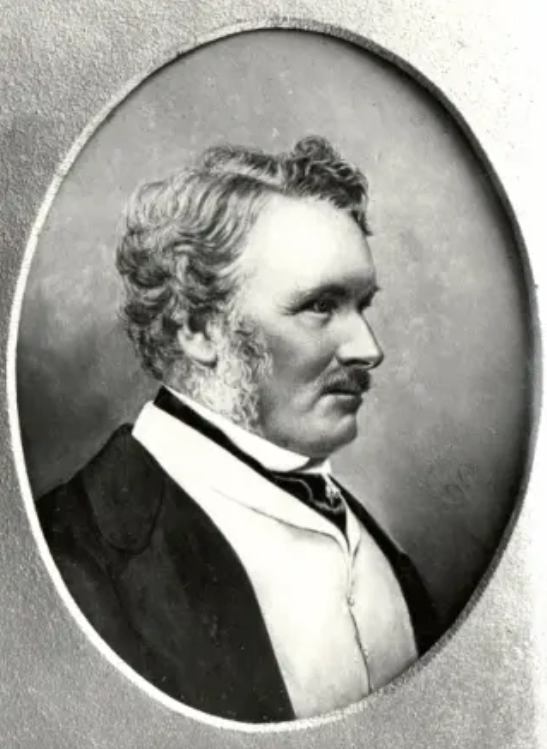 William Adams | First Superintendent of MarlboroughA key political figure in early Marlborough, Adams was elected as the first Superintendent of the newly formed Marlborough Province in 1860. He played a crucial role in establishing the administrative foundations of the region during its formative years of provincial government.
 Norman Brayshaw | Visionary local historian, museum and park founderA dedicated local historian whose passion for preserving Marlborough's heritage led to the establishment of Brayshaw Heritage Park. His vision and efforts were instrumental in creating a space where the region's history could be collected, displayed, and appreciated by future generations.
- William "Billy" Carr | Businessman, CouncillorA respected Blenheim businessman and local politician, Carr was known for his contributions to civic life and commerce in the late 19th and early 20th centuries. He served on the Borough Council and was involved in various community enterprises, reflecting the active role of business leaders in town development.
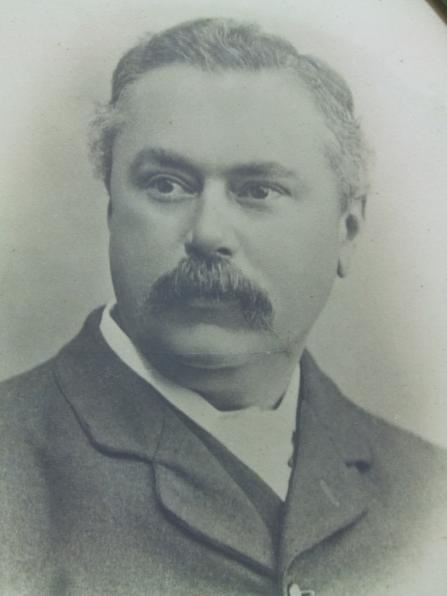 Dr. George Cleghorn | Pioneering surgeon & community leaderA pioneering surgeon and community leader in Blenheim, renowned for his advanced medical techniques, including one of NZ's first appendectomies, and for his principled stand in treating Māori patients. The Cleghorn Rotunda was erected in his honour.
- Sir Charles Clifford | Pioneer runholder, politicianAlong with his cousin Frederick Weld, Clifford was a key figure in establishing large-scale sheep farming in Marlborough in the late 1840s, particularly with Flaxbourne, their vast pastoral run. He later became the first Speaker of the New Zealand House of Representatives.
- Captain James Cook | Explorer, used Meretoto/Ship Cove as a baseThe renowned British explorer made his first New Zealand landfall in the Marlborough Sounds at Meretoto/Ship Cove in 1770. He used this sheltered cove as a base on multiple voyages, undertaking repairs, replenishing supplies, and making significant observations of Māori life and New Zealand's natural history.
- Joy Cowley | AuthorA celebrated New Zealand author, Joy Cowley ONZ, DCNZM, OBE, spent formative years in Marlborough. She is renowned for her prolific output of children's literature, including the beloved "Mrs. Wishy-Washy" series, as well as novels and short stories for adults, often exploring themes of human relationships and spirituality.
- Eileen Duggan | Poet, born in TuamarinaOne of New Zealand's most acclaimed early poets, Eileen Duggan OBE was born in Tuamarina in 1894. Her poetry often reflected her Catholic faith, Irish heritage, and observations of New Zealand life and landscape, earning her international recognition during the 1930s and 40s.
- Jules Dumont d'Urville | French explorerA prominent French naval officer and explorer, Dumont d'Urville led expeditions to New Zealand waters in the 1820s. During his voyage on the Astrolabe in 1827, he charted significant parts of the Marlborough Sounds and famously navigated the dangerous Te Aumiti / French Pass.
- William Henry Eyes | PoliticianAn early politician in Marlborough, Eyes served as Superintendent of the Marlborough Province from 1865 to 1870, following William Adams. He was actively involved in the political and administrative affairs of the region during a crucial period of its development.
- Rev. Samuel Ironside | MissionaryA Wesleyan missionary who played an important role in early European-Māori relations in the Wellington and Marlborough regions. He was involved in establishing mission stations and was present during significant events such as the Wairau Affray investigations, providing accounts and perspectives on colonial interactions.
- Mary Anne Muller | Women's rights advocateWriting under the pseudonym "Fémmina," Muller was a pioneering advocate for women's suffrage and rights in New Zealand, living for many years in Blenheim. Her influential 1869 pamphlet, "An Appeal to the Men of New Zealand," was a significant early call for women's political rights, contributing to New Zealand becoming the first country to grant women the vote.
- Dr. Stephen Lunn Muller | Magistrate, administratorThe husband of Mary Anne Muller, Dr. Muller was a respected Resident Magistrate in Blenheim. He played a role in the local administration and legal system of Marlborough during the colonial period.
- Nohorua | Ngāti Toa rangatira, Treaty signatory in MarlboroughAn influential Ngāti Toa chief and elder brother of Te Rauparaha, Nohorua was a key signatory to the Treaty of Waitangi in Marlborough in June 1840 at Horahora-kākahu Island. His participation was significant in the early interactions between Māori and the Crown in the region.
- William Pollard | Community benefactorA key community figure whose significant financial contribution in 1914 was instrumental in securing the land that would become Blenheim's beloved Pollard Park. His generosity helped establish one of the town's most important recreational and scenic assets for future generations to enjoy.
- Henry Redwood Snr. | Pioneer farmer and early pastoralistKnown as the "Father of the New Zealand Turf" for his contributions to horse racing, Redwood was also a significant pioneer farmer and early pastoralist in the Wairau Valley from the 1840s. He established the Hednesford stud and played a key role in developing the agricultural and pastoral industries in Marlborough.
- Dr. Thomas Renwick | Early settler, provincial councillorAn early Icelandic settler and medical doctor who became a prominent landowner and politician in Marlborough. Renwicktown (now Renwick) was named after him. He served as a provincial councillor and was involved in various aspects of the region's early development.
- James Sinclair | Early whaler & traderA notable early European resident of the Marlborough Sounds, Sinclair was a whaler and trader who established a whaling station at Te Awaiti / Tory Channel in the 1820s. He played a role in early cross-cultural interactions and the development of the region's maritime economy.
- Te Rauparaha | Ngāti Toa chiefA powerful and influential Māori chief of Ngāti Toa, Te Rauparaha dominated the Cook Strait region in the early 19th century. His influence extended into Marlborough, and he was a key figure in the Wairau Affray of 1843. He remains a significant figure in New Zealand history.
- Te Rangihaeata | Ngāti Toa chiefA Ngāti Toa chief and nephew of Te Rauparaha, Te Rangihaeata was also involved in the Wairau Affray. A formidable warrior and leader, he played a significant role in Māori resistance to European land claims in the region during the early colonial period.
- Captain Arthur Wakefield | Nelson settlement leaderThe leader of the Nelson settlement expedition and principal agent of the New Zealand Company, Wakefield was killed in the Wairau Affray of 1843. His actions and the disputed land claims he pursued were central to the tensions that led to this tragic confrontation.
- Sir Frederick Weld | Pioneer runholder, Premier of NZAlong with his cousin Charles Clifford, Weld established the Flaxbourne sheep station in the late 1840s, pioneering large-scale pastoralism in Marlborough. He later became the sixth Premier of New Zealand and Governor of various Australian colonies.
- Henry Williams | Missionary, Treaty translatorA prominent Church Missionary Society missionary who played a crucial role in the translation of the Treaty of Waitangi into Māori. He collected Treaty signatures in the Marlborough Sounds in June 1840, helping to extend British sovereignty over the region.